
Cyclops industry report · October 2026
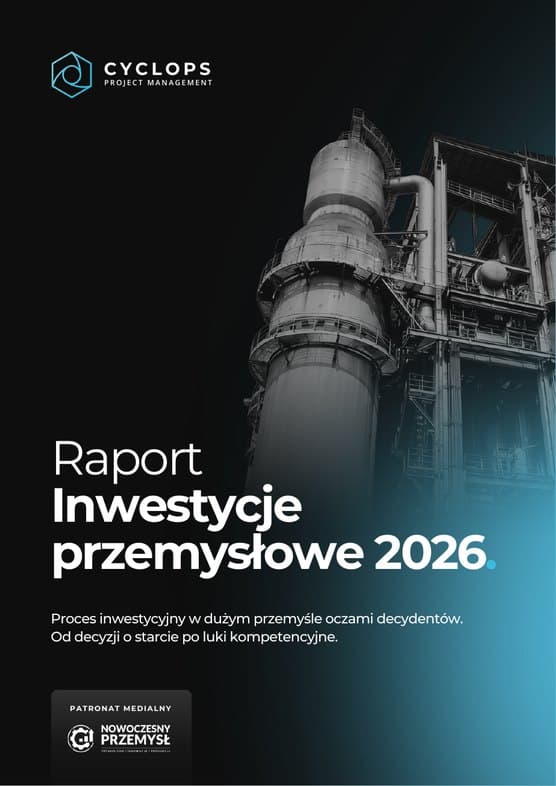
ReportIndustrial Investment 2026.
The investment process in large-scale industry through the eyes of decision-makers. From the decision to start to competence gaps.
- 20 directors and managers responsible for investments at large industrial companies
- Survey results set against Statistics Poland (GUS) data, with commentary from practitioners at Tarkett, Winkelmann, Polpharma and Alstom
- A 34-page PDF in Polish, ready to download as soon as you complete the form
The study in numbers
- 20
- CAPEX decision-makers from 20 large industrial companies
- 60 bn
- PLN in combined annual revenue of the companies surveyed
- 85%
- of respondents report a competence gap before construction starts
- 45 pp.
- between the gap (65%) and outsourcing (20%) in investment preparation
What's inside the report
A picture of Polish industry at a specific point in time
The report is not a statistical reflection of the entire sector. It takes an in-depth look at the investment environments where decisions on major projects are made. We separate hard data from expert commentary and clearly mark where the analysis ends and the market perspective begins.
- IntroductionForeword
- At a glanceFive key findings
- MethodologyHow was this report produced?
- Part IWho are the respondents?
- Part IIWhat drives investment?
- Part IIIWhat do success, difficulty and a competence gap mean?
- Part IVWhere does investment autonomy end?
- Expert panelFindings through the eyes of decision-makers
- Part VWhere is the weakest link?
Methodology
- Method
- Expert online survey, qualitative
- Timeline
- February to September 2026, from design to publication
- Questionnaire
- 20 questions in 3 formats
- Sample
- 20 technical decision-makers, 90% from companies with 250+ employees
Expert panel
Findings through the eyes of decision-makers
Numbers show the facts but don't explain them. Four practitioners who manage CAPEX projects at large manufacturers every day commented on two key findings of the report. The full commentary is available once you download the report.
Read the full commentaryEven when the data shows a gap, the cost of outsourcing a phase is often seen as higher than the potential benefits.
Keeping the initial, defining phases within the organisation ensures control over the project's assumptions, its further course and the cooperation with contractors.
A competence gap doesn't have to mean a problem that requires immediate external support.
Success depends not on complete self-sufficiency, but on the ability to recognise the moment when it's worth supporting the team with external expertise.
The Cyclops view
I wouldn't read the 60% result as a lack of planning, but as a possible sign of a shift away from rigid planning towards continuous management of a stream of projects.
Adam Matuszak, Project Manager, Cyclops
The cost of fixing a problem left over from the preparation phase grows by an order of magnitude with every subsequent project phase it survives.
Damian Cieplucha, Project Manager, Cyclops
About Cyclops
We manage capital investment projects in industry
Cyclops runs CAPEX projects on the owner's side: from concept and investment preparation, through procurement and contracting, to execution, commissioning and handover to operations. We work in EPCM, PMC and PMO models for companies in the food, pharmaceutical, metallurgical and energy sectors. This study grew directly out of our day-to-day work in the market.
Łódź
Piłsudskiego 87, 92-332 Łódź, Poland
+48 42 307 02 02
Vilvoorde (HQ)
Hendrik I-lei 45, 1800 Vilvoorde, Belgium
+32 15 34 77 75
One thing is beyond dispute. The scale and ambition of what Polish industry builds and produces are real. Machines can be bought quickly. Competences and processes grow more slowly. And often unevenly.